
In today’s fast-moving digital world, consumers are constantly bombarded with emails, advertisements, and app notifications. Yet, SMS continues to remain one of the most trusted and effective communication channels, thanks to its extremely high open rates and instant delivery. It allows businesses to reach customers directly, ensuring important messages are seen quickly without getting lost in the noise.
From OTP verifications and order confirmations to promotional campaigns and service alerts, bulk SMS plays a crucial role in enabling fast, reliable, and efficient communication. As India’s digital ecosystem continues to expand, selecting the Best Bulk SMS Service Provider in India has become increasingly important for businesses of all sizes. Platforms such as Viria provide scalable infrastructure, regulatory compliance, and robust APIs, making SMS communication smooth, secure, and highly effective for modern business requirements.
What Is a Bulk SMS Service?
A bulk SMS service enables businesses to send large volumes of text messages to customers instantly, without manual effort or scalability limitations. It serves as a core communication tool for modern enterprises, allowing them to reach hundreds or even millions of users with a single action.
Messages sent through a bulk SMS platform typically include:
- Promotional messages — discounts, special offers, sales announcements, and seasonal campaigns
- Transactional alerts — order confirmations, payment receipts, and shipping updates
- OTP verifications — secure one-time passwords for login and transaction authentication
- Appointment reminders — notifications for healthcare visits, education schedules, and service bookings
- Customer engagement campaigns — feedback requests, loyalty programs, and re-engagement communications
Top Bulk SMS Providers in India
1. Viria
Viria has established itself as one of the most dependable bulk SMS platforms operating in India today. The platform is purpose-built for businesses that cannot afford unreliable delivery — from growing startups dispatching their first OTP sequences to large enterprises managing multi-million message campaigns during peak seasons.
Key Features:
- Premium Telecom Routes: Rather than relying on resold or third-party routes, Viria maintains direct connections with India’s primary telecom operators — Jio, Airtel, Vi, and BSNL. This direct architecture results in faster delivery, fewer failures, and greater consistency across all message types.
- Real-Time Analytics Dashboard: Viria’s reporting interface provides live visibility into message delivery, failure reasons, campaign performance, and contact-level tracking, allowing teams to act on data rather than assumptions.
- Developer-Friendly SMS API: Built on RESTful standards, Viria’s API supports rapid integration with existing systems — whether a custom-built application, a popular CRM, or an e-commerce platform.
- Scalable Infrastructure: Viria’s cloud-native architecture is engineered to absorb sudden surges in message volume — a festive sale blast, a bank-wide OTP event, or a healthcare system alert — without compromising on delivery speed or success rate.
- 24/7 Customer Support: Messaging failures do not follow business hours. Viria’s support team operates around the clock, ensuring that any delivery issue, compliance query, or technical problem is addressed before it affects business operations.
2. MSG91
MSG91 operates as a unified cloud communication platform, combining SMS, WhatsApp, email, and voice services under a single interface — making it a strong choice for businesses managing multi-channel customer communication.
Key Features:
- Multi-channel Communication (SMS, WhatsApp, Email, Voice): Businesses can consolidate their entire outbound communication stack on one platform, reducing vendor complexity and simplifying campaign management.
- Developer-Friendly APIs: MSG91 offers thoroughly documented APIs alongside SDKs and ready-made plugins, enabling development teams to integrate messaging capabilities into any application architecture efficiently.
- OTP & Transactional Messaging: The platform is well-optimised for high-priority message types, including OTPs and system-generated alerts, with routing designed to minimise delivery latency.
3. Twilio
Twilio is a US-based cloud communications company with a strong global footprint, widely adopted by developer teams building programmable communication workflows at scale.
Key Features:
- Global SMS Coverage: Twilio’s network spans over 180 countries, making it a practical choice for businesses with international audiences or cross-border operations.
- Advanced Automation Tools: Twilio supports complex messaging workflows through programmable triggers, conditional logic, and event-based automation — suited for technically sophisticated communication architectures.
- Multi-channel Communication: Beyond SMS, Twilio integrates voice, WhatsApp, and video capabilities, enabling businesses to build omnichannel communication flows within a single API ecosystem.
4. Exotel
Exotel is an Indian CPaaS provider that brings together cloud telephony and SMS under one platform, making it particularly well-suited for businesses that need both voice and text communication managed centrally.
Key Features:
- Cloud Telephony + SMS Integration: Exotel unifies IVR systems, voice calling, and SMS messaging, allowing businesses to handle inbound and outbound communication from one place.
- Call Center Integration: The platform connects seamlessly with CRM tools and helpdesk software, giving customer support teams a consolidated view of every customer interaction.
- Enterprise-Grade Infrastructure: Exotel’s architecture is designed for high availability and reliability, capable of sustaining large volumes of simultaneous calls and messages.
- India-Focused Reliability: Built specifically for Indian telecom conditions, Exotel delivers better network compatibility and regulatory alignment than many globally oriented platforms.
5. Gupshup
Gupshup is a conversational messaging platform that goes beyond standard bulk SMS, offering businesses the ability to engage customers across SMS, WhatsApp, RCS, and AI-powered chatbot interfaces.
Key Features:
- Omnichannel Messaging: Gupshup enables businesses to communicate with customers on their preferred channel — whether SMS, WhatsApp, or RCS — from a unified platform.
- AI-Powered Chatbots: The platform includes bot-building tools that automate customer conversations across support, sales, and engagement workflows without human intervention.
- High-Volume Messaging: Gupshup’s infrastructure is built for scale, sustaining large broadcast campaigns with consistent delivery performance and minimal latency.
- Automation Tools: Campaign scheduling, workflow triggers, and behaviour-based messaging allow businesses to run sophisticated communication programmes with minimal manual effort.
6. Textlocal (Sinch)
Now operating under the Sinch brand, Textlocal built its reputation on an accessible, feature-rich dashboard that made SMS campaign management straightforward for non-technical marketing teams.
Key Features:
- SMS Campaign Management: The platform provides intuitive tools for building, scheduling, and managing promotional campaigns, suitable for teams without deep technical expertise.
- Analytics & Reporting: Textlocal delivers campaign-level reporting including delivery confirmation, open tracking, and engagement metrics to help teams assess performance.
- API Integration: Developers can connect Textlocal’s SMS functionality to external systems using its API, enabling automated message dispatch from third-party applications.
- Bulk Messaging at Scale: The platform supports large contact list management and high-volume sending for businesses running regular mass communication campaigns.
7. Kaleyra
Kaleyra serves enterprise and regulated-industry clients, offering a messaging infrastructure that prioritises security, compliance, and cross-border reach.
Key Features:
- High Delivery Rates: Kaleyra’s routing engine uses carrier-level partnerships and intelligent path selection to maximise delivery success across diverse recipient networks.
- Secure Messaging Infrastructure: End-to-end encryption and security protocols make Kaleyra a suitable choice for industries handling sensitive data, particularly banking and financial services.
- Multi-Country Coverage: The platform supports compliant messaging across multiple countries, catering to enterprises with regional or global communication requirements.
8. Fast2SMS
Fast2SMS is a cost-focused SMS platform that has gained popularity among early-stage startups and small businesses seeking affordable entry into bulk messaging without complex onboarding.
Key Features:
- Affordable SMS Plans: Fast2SMS offers some of the most competitively priced plans in the Indian market, lowering the barrier for businesses with tight communication budgets.
- Simple Web Dashboard: The platform’s interface is designed for ease of use, allowing users with no technical background to create and send campaigns within minutes.
- OTP & Promotional SMS: Fast2SMS supports both authentication-grade OTP messaging and standard promotional campaigns, covering the two most common business use cases.
Types of Bulk SMS Services
Knowing the various types of SMS services enables businesses to select the most suitable communication approach for their specific requirements.
- Transactional SMS: Transactional SMS is used for sending critical and time-sensitive information to users such as alerts, updates, and notifications. These messages are delivered instantly and are typically used for service-related communication.
- Promotional SMS: Promotional SMS is primarily used to promote products, services, offers, and marketing campaigns. It helps businesses reach a wide audience with offers, discounts, and campaign updates to drive engagement and sales.
- OTP SMS: OTP (One-Time Password) SMS is a secure form of transactional messaging used for user authentication, login verification, and sensitive transactions.
- Voice SMS: Voice SMS allows businesses to send pre-recorded voice messages directly to users’ phones, making it effective for reaching audiences who may not engage with text messages.
Modern communication platforms like Viria support all these SMS types, offering a unified and scalable solution for business communication needs.
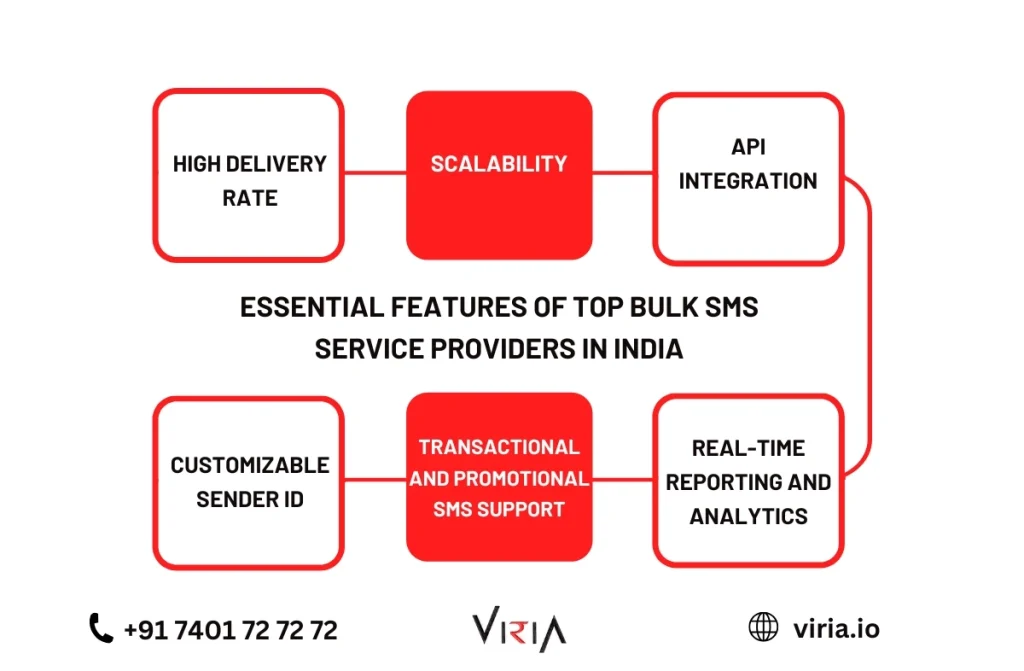
Key Features of a Reliable Bulk SMS Platform
Not all SMS platforms are equal. Here are the features that separate a professional-grade service from a basic reseller solution:
- Instant Delivery: Messages should reach recipients within 2–5 seconds of dispatch. Viria’s infrastructure is engineered for speed, with direct telecom connections that eliminate unnecessary hops.
- High Delivery Rate: A delivery rate of 99%+ is the benchmark for enterprise-grade SMS platforms. Viria’s intelligent routing automatically reroutes messages if a primary path fails, ensuring maximum reach.
- DLT and TRAI Compliance: Under India’s TRAI-regulated Distributed Ledger Technology (DLT) system, all businesses sending commercial SMS messages must register their organization, sender IDs, and approved message templates.Viria provides complete DLT compliance support, handling registration and template approvals so businesses can focus on communication rather than regulation.
- Custom Sender ID: Instead of receiving a message from a random numeric string, your customers see your brand name. Viria supports custom alphanumeric sender IDs for all transactional and promotional channels.
- API Integration: Viria’s REST API connects seamlessly with CRM systems, e-commerce platforms, mobile apps, and web applications. Whether you use Salesforce, Shopify, Zoho, or a custom-built system, integration is straightforward with well-documented endpoints and SDKs.
How Bulk SMS Works: Step-by-Step
Understanding the end-to-end flow helps businesses implement bulk SMS more effectively.
- Upload Contacts or Integrate API: Import your customer contact list via CSV, or connect your application directly to Viria’s API. For automated workflows, the API approach means messages are triggered programmatically without manual intervention.
- Create Message Template: Write your message and register the template on the DLT portal. For transactional and OTP messages, approved templates are mandatory under TRAI regulations. Viria’s team assists with this step.
- Select Sender ID and Schedule: Choose the sender ID that will appear on the recipient’s handset. Choose whether to send the campaign instantly or schedule it for a preferred date and time.
- Send via SMS Gateway: Viria’s gateway receives the dispatch request, processes it through the optimal telecom route, and transmits the messages to recipients.
- Track Delivery in Dashboard: Monitor delivery reports in real time. View delivered, pending, and failed message counts. Use this data to refine your contact list and improve future campaigns.
Bulk SMS Use Cases Across Industries
The versatility of bulk SMS is one of its greatest strengths. Virtually every industry that communicates with customers can benefit:
- E-commerce and Retail: Order confirmations, shipping status updates, delivery alerts, return initiation, and festive sale campaigns. SMS ensures customers stay informed at every stage of their purchase journey.
- Banking and Fintech: OTP delivery for mobile banking logins and transactions, fraud alerts, account balance notifications, and credit card usage confirmations. Speed and security are non-negotiable in this sector.
- Healthcare: Appointment reminders, lab report availability notifications, prescription refill alerts, and health camp promotions. SMS reduces no-show rates and keeps patients engaged.
- Education: Examination result announcements, attendance alerts, fee payment reminders, and admission notifications. Schools, colleges, and ed-tech platforms rely on SMS to reach students and parents reliably.
- Real Estate: Site visit confirmations, property launch alerts, EMI reminders, and offer notifications. Bulk SMS helps real estate companies stay top-of-mind with high-intent leads.
Conclusion
The bulk SMS market in India is highly competitive, with many platforms offering similar features and pricing. However, what truly distinguishes a reliable provider is infrastructure stability, strong compliance support, and responsive customer service.
Viria is designed to be a dependable communication partner for businesses. It offers premium telecom routes, full TRAI and DLT compliance, real-time analytics, and a dedicated support team focused on ensuring uninterrupted messaging performance. This makes it suitable for businesses that require consistency and scale in their communication workflows.


